
BASEMENT WATERPROOFING · LIMA, OH
Interior Drainage & Sump Pumps in Lima, OH
Interior drainage is the right answer when water arrives from underneath — up through the slab, or in at the joint where the wall meets the floor. In Lima that is the most common situation there is, because the clay loam under the city holds a perched water table that sits above many basement floors in spring. A proper system is perforated drain tile installed below floor level in washed gravel, routed to a sealed sump basin. It is also the most oversold service in this trade, and the shortcut version — a plastic channel glued to the top of your slab — will not manage this ground. Call (419) 731-9193 for a free on-site inspection.
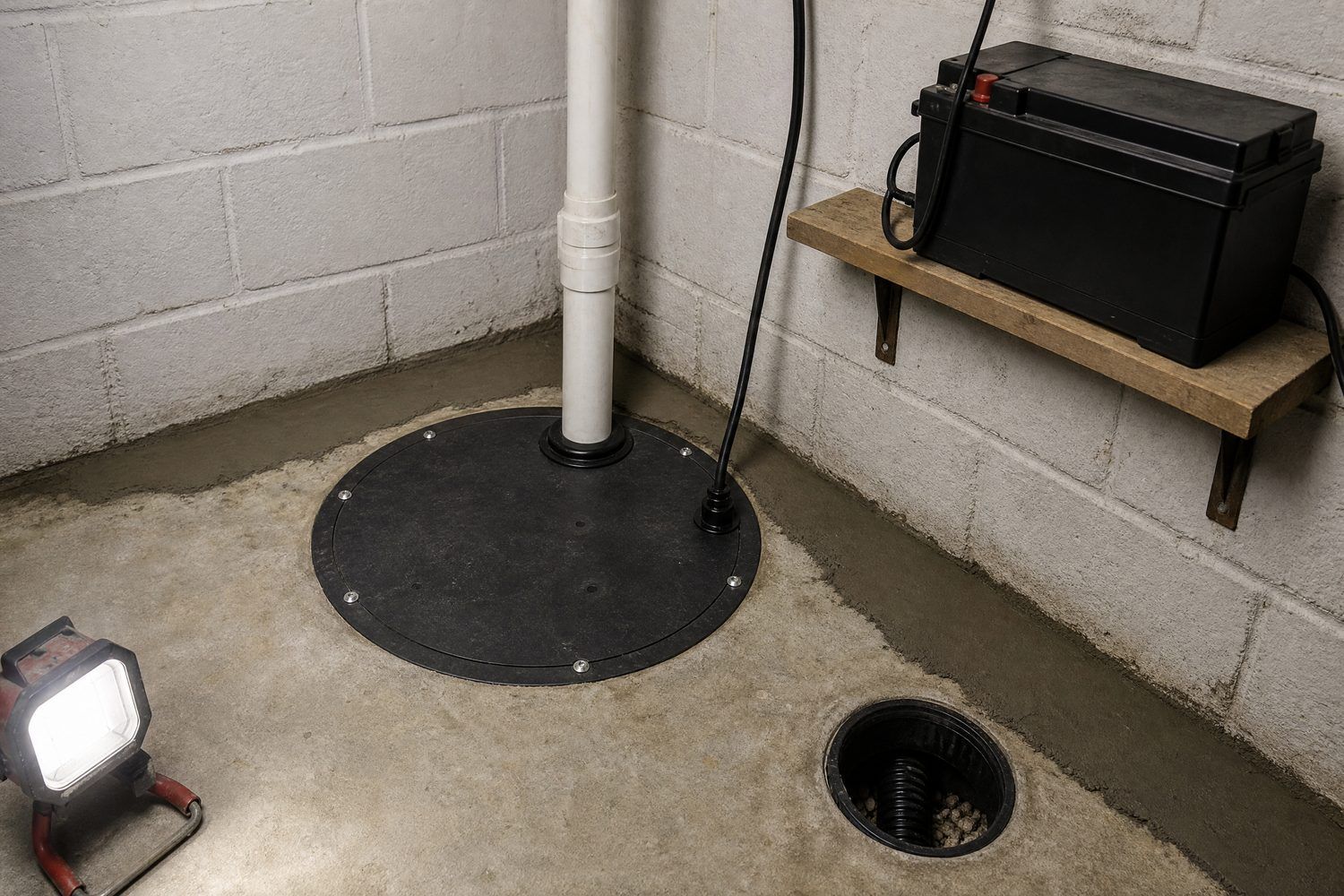
What interior drainage involves
We cut a channel in the concrete slab along the base of the wall, excavate below floor level, and bed perforated drain pipe in washed gravel so water reaches it from underneath rather than having to rise to the surface first. That pipe slopes to a sump basin set into the floor, and the basin gets a sealed lid — bolted around the rim with a rubber grommet where the discharge line exits. The slab is then patched back over the tile. On a hollow block wall we also drill weep holes into the base course so the water standing inside the cores can drain into the new system instead of staying in the wall.
The part that decides whether it works is invisible once the concrete goes back down, which is why the shortcut version is so common. Real drain tile sits below the floor slab in gravel. The cheap alternative is a plastic channel adhered to the top of the slab at the wall joint, which catches water only after it has already come up through or across the floor and does nothing about hydrostatic pressure under the slab. In Lima clay with a perched water table, that difference is the whole job. We also install a battery backup on every pump, because the storms that flood basements here are the same storms that take the power out.
When you need interior drainage: signs and situations
These are the symptoms that point specifically to water arriving from below rather than running in from outside.
- Water appearing at the joint where the wall meets the floor, rather than running down the wall face
- Damp or wet patches in the middle of the floor, away from any wall
- The problem is worse across the whole of spring than during any single heavy storm
- An existing sump pump that runs continuously in March and April
- Efflorescence and a damp tide line low on a block wall, with the upper courses dry
- Hairline cracks in the slab weeping water, or a floor drain backing up during wet weather
Get Your Free Quote
Why water comes up from below in Lima
Lima was built in the Great Black Swamp, a glacial wetland that covered northwest Ohio until it was artificially drained in the nineteenth century for farming and settlement. That drainage depends on ditches, field tile and pumping — it is engineered infrastructure, not a natural change in the landscape, and the water still wants to be where it always was. Underneath the city is clay loam over glacial till. The Allen County soil survey documents conditions to a depth of about six and a half feet and records a seasonal high water table within that range, which is shallower than most basement excavations. Clay does not transmit water downward. So when rain falls, water saturates the topsoil, reaches the clay, and stops — perching there and spreading sideways until it finds the lowest opening available.
Often that opening is your basement. A basement floor sitting at seven or eight feet is below the perched water level, which means water is pressing up against the underside of the slab and inward at the wall-floor joint. There is a second factor specific to this city: five lowhead dams built between 1931 and 1956 sit inside the Lima city limits on the Ottawa River — the one locals call Hawg Creek. Those impoundments were built to hold water where the stream bed would otherwise run dry in summer, and they keep the local water table elevated year-round for the homes near them. It is the reason a house on one street takes water every spring while a neighbor three streets away on higher ground never has.
What affects the cost of interior drainage in Lima
Interior drainage is priced by the linear foot of wall treated, then adjusted for what the job actually requires. Full ranges are on our cost page.
- Linear footage — one wall versus a full perimeter is the single biggest variable
- Whether the wall is hollow block needing cores drilled and drained, or poured concrete
- Slab thickness and whether there is reinforcing mesh or rebar to cut through
- Pump specification — horsepower, cast iron versus plastic, and battery backup
- Discharge routing distance, since the outlet must go to daylight or storm drainage and far enough out not to feed straight back
- Obstructions — a finished basement, a furnace, a water heater or shelving along the work line
Adding to an existing system or starting over
If you already have a sump and it is losing the fight, the first question is what kind of system is actually down there. A basin with a pump and no drain tile feeding it is not a drainage system — it is a hole that collects whatever reaches it. Adding tile to that is straightforward and preserves what you have. If there is real tile below the floor and the pump simply cannot keep up, replacing the pump with a properly sized unit and adding a battery backup is often the entire fix, and it costs a fraction of a new system.
Where we recommend starting over is when the existing tile has silted up, which happens when it was installed without a filter fabric or bedded in the wrong material. Clay fines migrate into the pipe over ten or fifteen years and eventually it carries nothing. You can sometimes jet it clean, and we will try that first, but a tile line packed with Allen County clay usually has to be replaced. The tell is a system that used to work and gradually stopped without the pump ever failing.
Our step-by-step process
- STEP 1
On-site diagnosis — we determine that water is arriving from below rather than outside, and confirm the wall type
- STEP 2
Written fixed-price quote scoped to the linear footage and conditions we found
- STEP 3
Plumbing permit pulled from Allen County Public Health before any work begins
- STEP 4
Protection and setup — contents moved, floors covered, dust containment for concrete cutting
- STEP 5
Slab cut and excavated along the wall base, below floor level
- STEP 6
Perforated tile bedded in washed gravel with filter fabric, sloped to the sump basin; weep holes drilled in block cores where applicable
- STEP 7
Sump basin set, pump and battery backup installed, sealed lid bolted with a grommeted discharge, line routed to daylight or storm drainage
- STEP 8
Slab patched, county inspection, system tested with water, and a walkthrough showing you how to test it yourself
Timeline and what to expect
One or two walls is typically a one to two day job. A full perimeter runs two to three days. The first day is the loudest by a wide margin — cutting concrete is genuinely disruptive, and you should plan for dust and noise even though we contain both. The concrete patch is walkable the same day and fully cured in about a week, so hold off on relaying flooring for that long. The county inspection is scheduled after installation and is usually quick. Unlike exterior work, interior drainage is not weather-dependent, which means we can do it in February or in the middle of a wet April — often a real advantage, since spring is exactly when you discover you need it.
GOOD TO KNOW
FAQs
How do I know if my drain tile is real or just a surface channel?
Look at where it sits. A real system is buried — you should see a patched strip of concrete along the base of the wall, roughly a hand's width across, and an inspection port somewhere along it. A surface channel sits on top of the existing slab and is usually a white or grey plastic profile glued at the wall-floor joint with no concrete work at all. If the floor along your wall was never cut, there is no tile below it.
Why does my sump pump run constantly in spring?
Because the water table is above your basement floor, which in Lima is normal for March and April rather than a sign of a faulty pump. Clay loam over glacial till perches water near the surface, and the county soil survey documents that seasonal high water table within about six and a half feet — shallower than most basement floors. A pump running frequently in spring is doing its job. A pump running continuously in August is telling you something else, and that is worth a look.
Where does the water actually go?
To daylight or to storm drainage, far enough from the foundation that it does not simply return. It cannot go into the sanitary sewer — Allen County Sanitary Engineering rules specifically prohibit connecting sump discharge lines to the building sanitary drain. This confuses people, because city ordinance separately requires that wastewater be connected to the public sewer. The distinction is the type of water: sewage goes to the sanitary sewer, groundwater does not.
Do I need a battery backup?
In Lima, yes, and we install one on every system. The storms that raise the water table are the same storms that knock out power, and a sump pump with no power is a hole in your floor. During the June 2015 flooding the Ottawa River crested at 21.20 feet — an all-time record — and plenty of homes lost power in the same window. That is the specific scenario a backup exists for.
Will this fix a wet block wall too?
Partly, and this is worth understanding before you buy. Drilling weep holes at the base course lets the water standing inside the hollow cores drain into the new tile, which stops the wall holding water. What it does not do is repair the deteriorated mortar joints that let the water in, or fix whatever is putting water against the outside of the wall. On many Lima houses the honest answer is drainage plus repointing, and we will tell you if that is the case rather than selling you half the job.
Find out if drainage is what you actually need
Free on-site inspection and a written fixed price. If the honest answer is grading and downspouts instead of a drainage system, we will tell you that.